
Emily Paterson
Learning Experience Designer
A Boreal Balance: Gamified Learning at the MSU Museum
Duration: January – November 2023
Overview: An interactive mobile game created to enhance the visitor learning experience of a traveling Smithsonian exhibition on display at the MSU Museum.

Background:
I was selected to be a part of a team of five interdisciplinary students, with expertise spanning from game design to integrative biology, to design and develop a gaming experience for the Smithsonian exhibition “Knowing Nature: Stories of the Boreal Forest.”
With its first appearance at the MSU Museum in April 2023, “Knowing Nature” is an exhibition centered on communicating the rich biodiversity and global importance of the North American Boreal through commissioned objects and the first-person perspectives of their Indigenous peoples.
Audience & Challenge:
A beautifully designed and well-researched exhibition, “Knowing Nature” aims to communicate crucial themes of climate change to an intended target audience of middle school (grades 6-8) and above. However, it often struggled to connect the detailed, word-heavy panels of scientific concepts to incoming visitors, especially those of its intended audience. As I found in my research, it was common for visitors to spend under two minutes in the gallery, glancing at photographs and drifting across the existing hands-on interactives (petting moss or feeling animal tracks), rather than engaging with the written content. To address this challenge, our team came up with the following question:
How does a digital game impact audience engagement and attainment of exhibition learning objectives?
Goal:
With this question in mind, we aimed to create a game-based design solution that encouraged further exploration into the panel content. We wanted visitors to seek out the exhibition text and apply its insights into their own lives, making note on how they could adjust their behaviors locally for the better of the boreal on a global scale. As we designed the game, we wanted it to meet three of the exhibition’s existing learning objectives:
- Visitors will understand why the boreal forest plays a critical role in mitigating the climate crisis.
- Visitors will reflect upon their own relationship to their environment.
- Visitors will appreciate that the boreal forest is threatened by the cumulative effects of human activity coupled with a changing climate.
First Ideation: Learning the Ropes
With the task of creating the game before the exhibition was even installed, we began by brainstorming and experimenting with different platforms, storylines, and game mechanics.
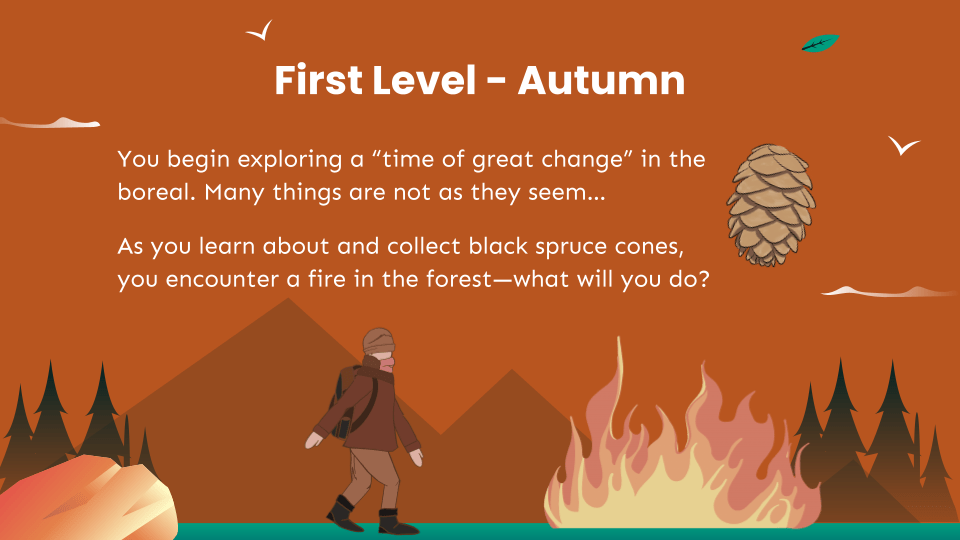
Once we surpassed the initial introductions and brainstorming during the Spring of 2023, we began working on a platformer game that was similar to a virtual scavenger hunt. However, as we reached the end of that semester, we quickly realized that our game was too focused on the fun game mechanics (of climbing and jumping) as opposed to communicating our original learning outcomes.
Second Ideation: Laying the Foundation
At that point, as we ushered in the beginning of the summer, I started to feel much more confident in my abilities to translate the exhibition content into a cohesive storyline. With a need to quickly pivot, I felt more comfortable occupying a greater leadership role, which guided and shaped the foundation of the rest of our team’s work.
Over the summer, we held 1-2 weekly team meetings, in which we would discuss our hopes and ideal outcomes for the game. We drew inspiration from two existing games: the style of Carto and mechanics of Feed the Dingo. With both these sources in mind, we wanted to create a game that encouraged users to directly interact with different scenarios and make choices based on existing information. Then, they would see the outcome of their choices on the animals, humans, and larger environment of the boreal.
After our conversations, I worked to synthesize our findings and inspirations into sketches and eventually an interactive Figma prototype of the game concept. Drawing upon sample frames of Carto gameplay, I constructed my own environmental scenarios based on the themes we identified within the exhibition panels. These became our three levels.

Game Levels:

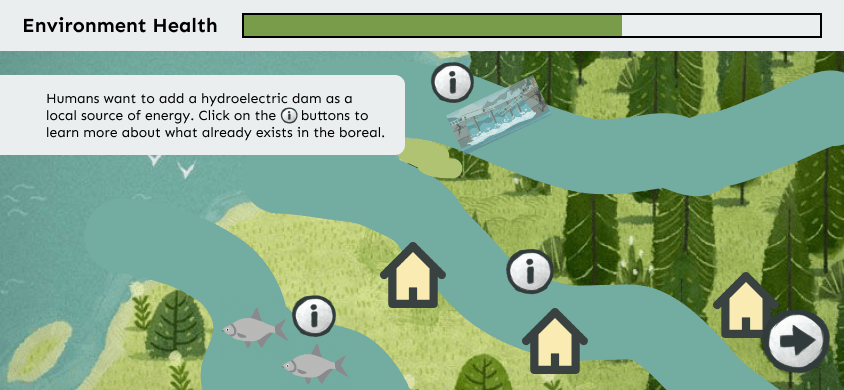
Rivers & Dams: Determine the best place for an energy-producing dam, keeping in mind the neighboring human and sturgeon populations.
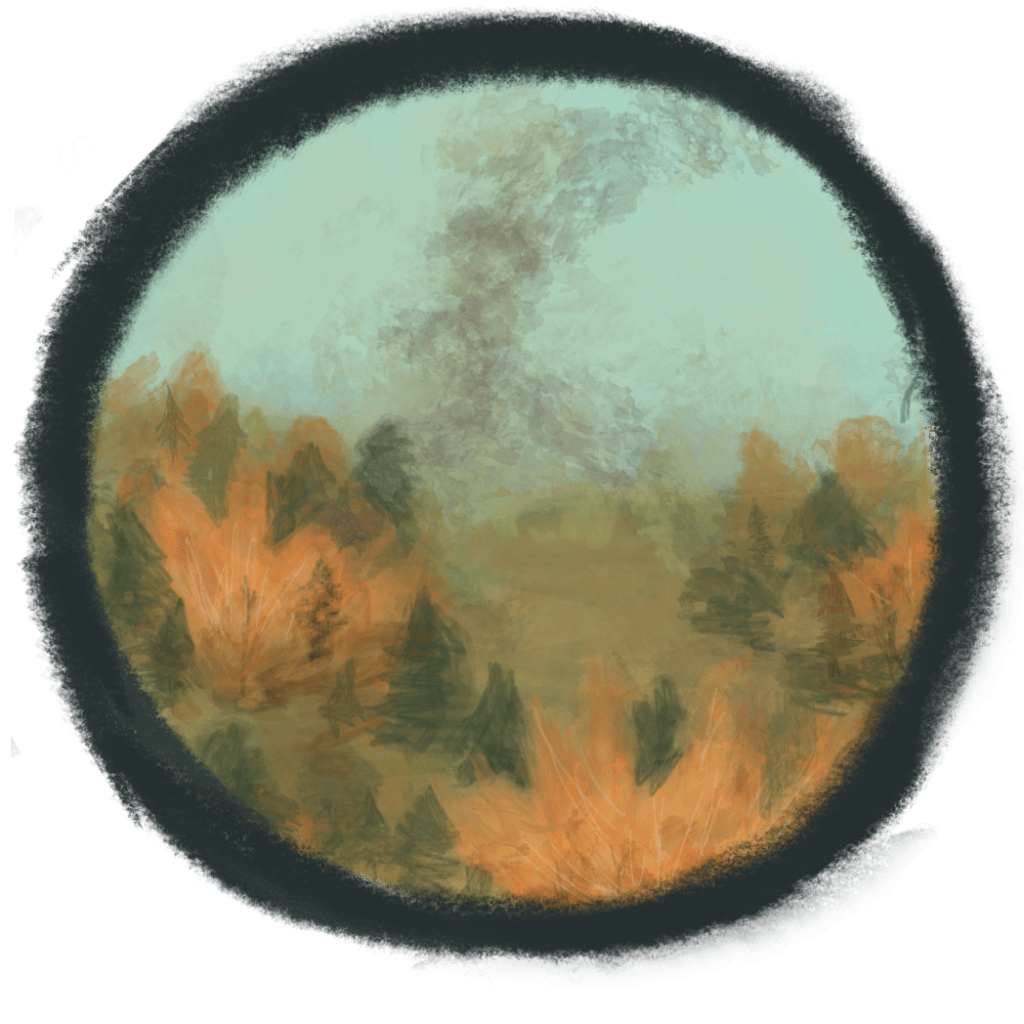
Fires & Forest: Practice effective forest management skills to fight fires, protecting plants & people in the process.

Logging & Migration: Examine existing logging practices to decide what approach will provide us with a sustainable future.
Level Structure
Initial Priming Question
Each level would begin with an initial multiple choice question based on the exhibition textual content. Visitors could click on the ? button to reveal a hint that would direct them to the exact panel to find the answer to the question. Knowing the answer to this question would help the visitor have an easier time solving the upcoming environmental scenario.
Environmental Scenario
Visitors would first be confronted with a challenge about balancing the needs of humans, animals, and plants within the natural processes of the boreal forest. They can explore the scene, selecting info buttons to learn about what is already present in the environment. Then, they are prompted to make a decision: If we have to interfere with the environment, what path would be best for all stakeholders involved? Once they make their choice, the visitor is confronted with the consequences of their actions—whether it helped or hurt.
Reflection
As I created these scenarios, it became increasingly clear that there are a lot of nuances even to the best of solutions. A hydroelectric dam (a source of green, clean energy) is also a source of pollution for any neighboring humans or animals. Even if we rebuild a new dam out of an older one, we must also reflect on the choices that we all make to create a demand for this energy in the first place.
With that in mind, I wanted to add a reflective component to target the root of our behaviors (overconsumption) that result in these problems. On each level, I asked the visitors to think about “What choices can YOU make?” to prevent this problem from happening.

![It's dry season and fires are starting to get out of control in the forest. Click on the [info] buttons to learn more about the areas at risk of fire. A pop up of "A small grove of older black spruce trees face a small fire." "A small grove of trees faces a forest fire near a community of people." "A dense grove of diverse tree species is near a large fire."](https://emilypaterson.com/wp-content/uploads/2024/03/kn-gif.gif?w=480)

Building the Game
Once I helped the team shape the foundation of the game using my wireframes, we were then able to get started on building the playable version of the prototype on Unity. While some of my teammates worked on the development, I continued to refine our concept and write the entire narrative script for the game.
Alongside this development, we also had to create a visual identity for the game. Once again drawing inspiration from Carto, we decided upon a fun, yet elegant watercolor approach to showcase the beauty of the boreal forest. I used Procreate to draw custom icons, backgrounds, and other art assets to support our team in assembling the style of our game.
Outcome & Impact
At the end of almost a year’s worth of work, we ended up with a finished product of a playable mobile game designed to encourage visitors to manage limited resources and address problems in the Boreal, while keeping humans and animals happy and healthy. And, excitingly, our game will continue to travel with the exhibition!
This project had an incredible impact on me, allowing me to make an impact on educating visitors on a crucial global issue. It also gave me a chance to shine as a writer and designer in a game medium that I formerly had little knowledge in. I was able to act as a communicative bridge between my teammates, who were experienced in either game design or science, and the end user of our game.
Emily Paterson
Learning Experience Designer
Send me an email at
emilyypatersonn[@]gmail.com
 Emily Paterson